

One of our most-seen posts is The Hidden Process Behind Every AI Answer, our plain-language walkthrough of how large language models learn. Google likes it. In last two months, it collected 20.7K impressions in Google Search.
The click-through rate? 0.4%. That's roughly 80 clicks.
We can't prove AI answers took the rest. But plenty of marketers know the pattern: impressions hold, clicks drop, and someone on the team asks, "We rank on Google, so why don't AI answers mention us?"
Here's our take. We still think AEO won't kill SEO, and good SEO remains the entry ticket. But being cited is now a separate game from being ranked, with its own scoring. To play it, you need to understand how AI search chooses sources: what happens between a question and the handful of links under the answer.
Let's break it down.
How AI search chooses sources? From your question to a cited answer
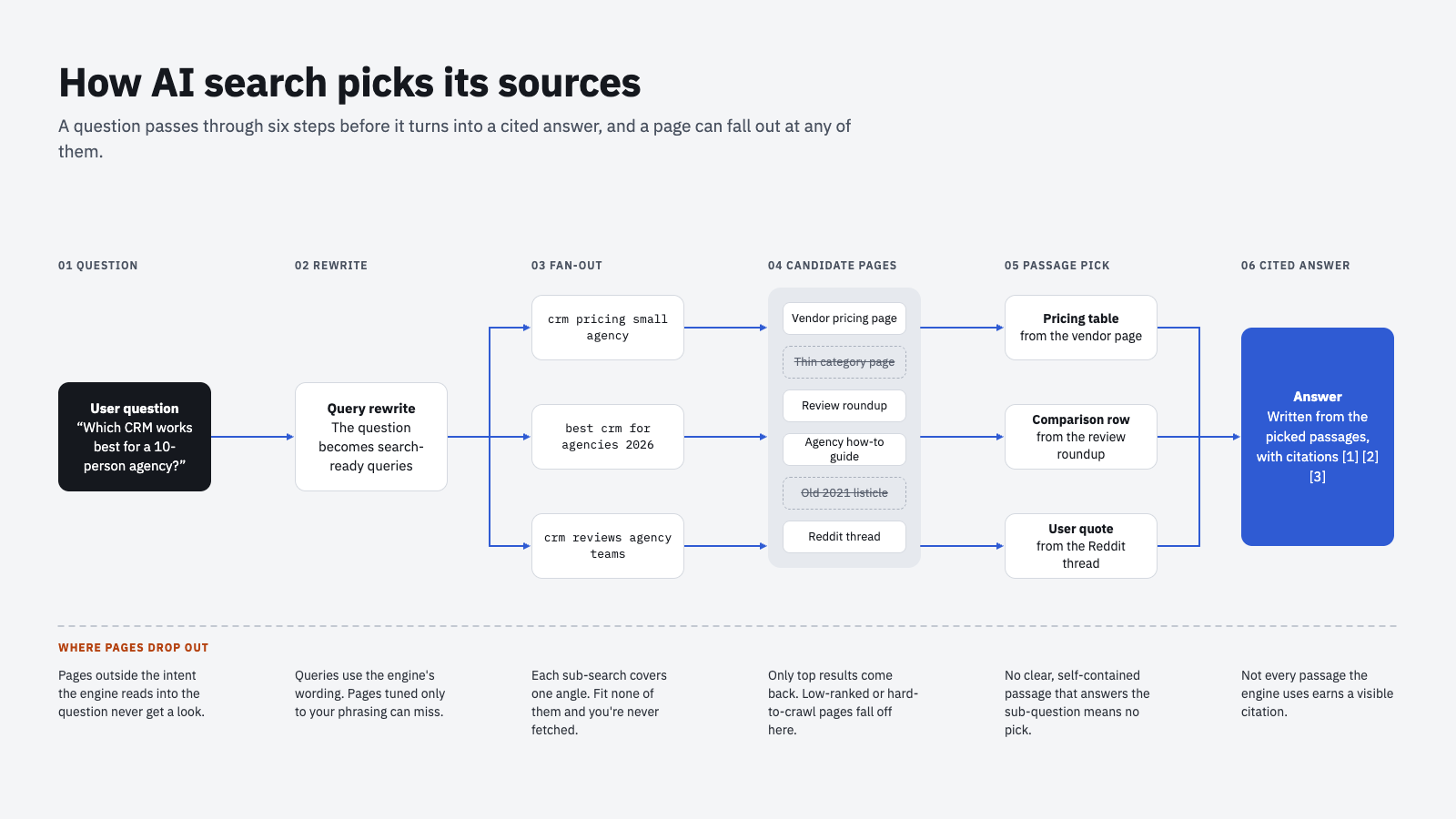
AI search engines don't run one search. They decide whether to search at all, rewrite your question into several narrower queries, pull candidate pages for each one, pick the passages that answer best, then write the answer and link the pages they used. Your page can drop out at any of those steps.
Both companies describe parts of this. Google's AI features documentation (updated December 2025) says AI Overviews and AI Mode may use a "query fan-out" technique, issuing multiple related searches across subtopics and data sources. OpenAI's ChatGPT search help page says ChatGPT "typically rewrites your query into one or more targeted queries" when it uses outside search providers, and may send "additional, more specific queries" after reviewing the first results.
Put together, it looks like this:
- Search or remember. Not every answer touches the live web. In Prefer's July 2026 test of 47 buyer questions, ChatGPT answered 29 from memory with no citations at all. (Prefer sells AI visibility tools and calls the single run directional.)
- Rewrite. Your question becomes one or more search queries.
- Fan out. Those queries split into sub-questions across subtopics.
- Retrieve. Each sub-query returns candidate pages. An Ahrefs study of 1.4 million ChatGPT prompts, published in April 2026, found ChatGPT retrieves dozens of URLs per prompt and cites only about half of them.
- Pick passages. According to the same Ahrefs study, ChatGPT judges candidates on what comes back with each result (title, URL, snippet) before deciding which pages to open.
- Answer and cite. The model writes the answer and links the pages it drew from.
To be clear: this is a simplified model. Each engine runs its own version, and none of them publishes the full recipe.
Ranking still matters, but not the way it used to
Ranking still gets you into the candidate pool, but a page-one position no longer guarantees a citation. Ahrefs data from 2026 shows only 38% of AI Overview citations came from Google's top 10, partly because fan-out sends the engine to pages ranking for sub-questions you may never have targeted.
According to Ahrefs data reported by Search Engine Journal in March 2026 (863,000 keywords, 4 million AI Overview URLs), 38% of pages cited in AI Overviews also ranked in Google's top 10 for the same query, down from 76% in Ahrefs' July 2025 study. Another 31.2% ranked in positions 11 to 100, and 31.0% ranked below position 100.
One honest caveat: Ahrefs says part of that drop comes from better parsing that now detects more citations, so the two studies aren't directly comparable. A separate BrightEdge analysis, published in February 2026 with a different method, put the top-10 overlap at about 17%.
Here's the thing: fan-out cuts both ways. You can be cited for a sub-question you never targeted, and lose the citation on a head term you rank first for.
Ranking still counts. The 2026 Ahrefs ChatGPT study found that 88% of the URLs ChatGPT cites come from its general search index, so "your content needs to rank." Ranking gets you into the pool. It doesn't get you into the answer.
And the answer is where the remaining clicks are. The figures below come from different panels and dates, so read each row on its own:
Each engine has its favorite sources
ChatGPT, Perplexity and Google don't read the same web. In the data we've seen, ChatGPT leans on Wikipedia, Perplexity on Reddit and YouTube, and Google's AI Overviews on a mix of Reddit, YouTube, Quora and LinkedIn. A citation on one engine tells you little about the others.
The overlap between engines is tiny. In Prefer's study, only 5 of 713 cited domains were cited by all four engines tested, and about 75% were cited by one engine only.
Now the Reddit stat that surprises people. A Semrush study of 217,000 prompts (November 2025) found that 80% of Reddit posts cited by AI search tools had fewer than 20 upvotes, and over half came from Q&A threads. The engines want the clearest answer to a specific question, not the most popular post.
These habits shift fast, so treat the table as a starting point and re-test.
Why your site gets skipped?
Most skipped sites fail on one of five things: AI crawlers can't reach the page, the answer is buried, the content is stale, nobody else mentions the brand, or the page adds nothing new. Each one cuts your odds at a different step of the pipeline.
- Bots can't reach you: you never enter the candidate pool.
- Your answer is buried: you're retrieved but not picked.
- Your content is stale: a fresher page wins the tie.
- Nobody else mentions you: the engine has little reason to trust you.
- You say nothing new: another page covers it equally well.
AI bots can't reach you
Google's documentation says a page must be indexed and eligible to show with a snippet to appear as a link in AI Overviews or AI Mode, and lists making sure crawling is allowed "in robots.txt, and by any CDN or hosting infrastructure." So a nosnippet tag can keep you out too.
OpenAI's crawler documentation says sites that opt out of OAI-SearchBot "will not be shown in ChatGPT search answers." That's a different bot from GPTBot, which handles training. A CDN or firewall rule can block both without anyone in marketing knowing.
Your answer is buried
The Ahrefs ChatGPT study found that titles of cited pages were semantically closer to the prompt than titles of pages ChatGPT retrieved but skipped (0.602 vs 0.484 similarity), and closer still to its fan-out queries (0.656). Pages with natural-language URL slugs had an 89.78% citation rate, against 81.11% without. (Ahrefs estimated similarity with open-source models, since ChatGPT's own scoring is private.)
Our reading: say what the page answers in the title, the URL and the first sentences under each heading. An answer hidden in an image, a tab or paragraph six is hard to lift.
Your content is stale
An Ahrefs study of 17 million citations (July 2025) found that AI-cited content was 25.7% fresher on average than pages in organic results, and that ChatGPT's citations were 458 days newer than organic Google results.
But freshness alone won't save a weak page. The 2026 Ahrefs study found that within a single retrieval set, age works more like a tie-breaker: "Relevance still does the heavy lifting." Update for real, not by changing the date.
Nobody else talks about you
An Ahrefs study of 75,000 brands (May 2025) found branded web mentions correlated with AI Overview visibility at 0.664, while backlinks correlated at only 0.218. That's correlation, not proof, but it fits: the engines read the open web, and most of it isn't your site. We covered the ways tools mention your brand in a separate post.
You say nothing new
The GEO paper by Aggarwal et al. (KDD 2024) tested content changes on generative engines and found methods like adding statistics, quotations and cited sources raised visibility by up to 40%. Those were lab conditions on 2023 to 2024 engines, not a promise. Still, the logic holds: if your post repeats what 50 others say, the engine has no reason to pick yours.
What we'd do this quarter - and you should do it too?
We'd start with access, then structure, then reputation. Check that AI crawlers can reach you, rewrite your top pages so the answer comes first, refresh them with real updates, earn mentions where the engines read, and publish data nobody else has. None of it guarantees a citation. All of it raises the odds.
Our order of attack:
- Check bot access this week. Review robots.txt for Googlebot and OAI-SearchBot, your CDN and firewall bot rules, and any nosnippet tags. Cheapest fix, biggest downside if skipped.
- Rewrite your top 10 pages answer-first. Put a 40 to 60 word direct answer under every H2, and make titles and URLs say what the page answers. (We did that in this post, so you can judge the result.)
- Refresh dates and data, for real. New numbers, new examples, an honest "last updated" date.
- Earn mentions on Reddit, LinkedIn and industry sites. Answer real questions in Q&A threads without pitching. Publish LinkedIn articles under named experts, not only the company page. Semrush found most cited LinkedIn posts had a modest 15 to 25 reactions, and about 75% of cited authors posted at least five times in four weeks. Consistency beats virality.
- Add one original stat per quarter. A survey, a benchmark, your own data. It's the thing nobody can copy.
What we wouldn't do: chase llms.txt or special AI markup. Google's documentation is blunt: "You don't need to create new machine readable files, AI text files, or markup to appear in these features. There's also no special schema.org structured data that you need to add." If someone sells you llms.txt as the fix, ask for the evidence.
How to tell if it's working?
Track three things: AI Overview and AI Mode traffic in Search Console, referral visits from AI assistants in GA4, and a monthly check of the questions your buyers ask. No single number tells the whole story, so watch the trend across all three.
Google says traffic from AI features is counted in the Search Console Performance report, under the "Web" search type, mixed in with regular results. In GA4, watch referrals from sources like chatgpt.com and perplexity.ai.
Then check by hand. Monthly, run the same 20 buyer questions through ChatGPT, Perplexity and Google AI Mode, and log who gets cited, including your competitors.
So, why don't AI answers mention you?
Back to our 0.4%. Ranking got that post seen. It didn't get it picked.
AI search engines aren't mysterious. They're picky. They want pages they can reach, answers they can lift, current facts, and brands other people vouch for. A higher bar than ranking, but a fair one.
The question is: when your buyer asks an AI about your category tomorrow, which of your pages gives it a reason to cite you?
FAQ
How does ChatGPT decide which websites to cite?
When ChatGPT searches the web, it rewrites your question into targeted queries, pulls results mostly from its general search index, and cites roughly half of what it retrieves, according to Ahrefs' 2026 study of 1.4 million prompts. Pages whose titles and URLs closely match its fan-out queries are more likely to be cited. Many answers skip search and come from memory, with no citations.
Do I need to rank on page one to appear in AI Overviews?
No. Ahrefs data reported in March 2026 found only 38% of AI Overview citations ranked in Google's top 10, and 31% ranked below position 100. Your page does need to be indexed and eligible for a snippet in Google Search, and strong rankings for related sub-questions still help.
Does llms.txt help me get cited?
Not in Google, by Google's own account. Its documentation says you don't need new machine-readable files, AI text files or special schema to appear in AI Overviews or AI Mode. We haven't seen independent evidence that llms.txt raises citations elsewhere either, so we'd put the time into content and crawler access first.
How long does it take to start getting cited by AI search?
Technical fixes can register quickly: OpenAI says changes to robots.txt take about 24 hours to reach ChatGPT search. Content and reputation work takes longer, and no one can promise a date or a citation. We plan in quarters and check the same buyer questions every month.
.png)


.png)

.svg)