Editor’s note:
We’re kicking off Season 2 of Growth Talks with someone from our own backyard.
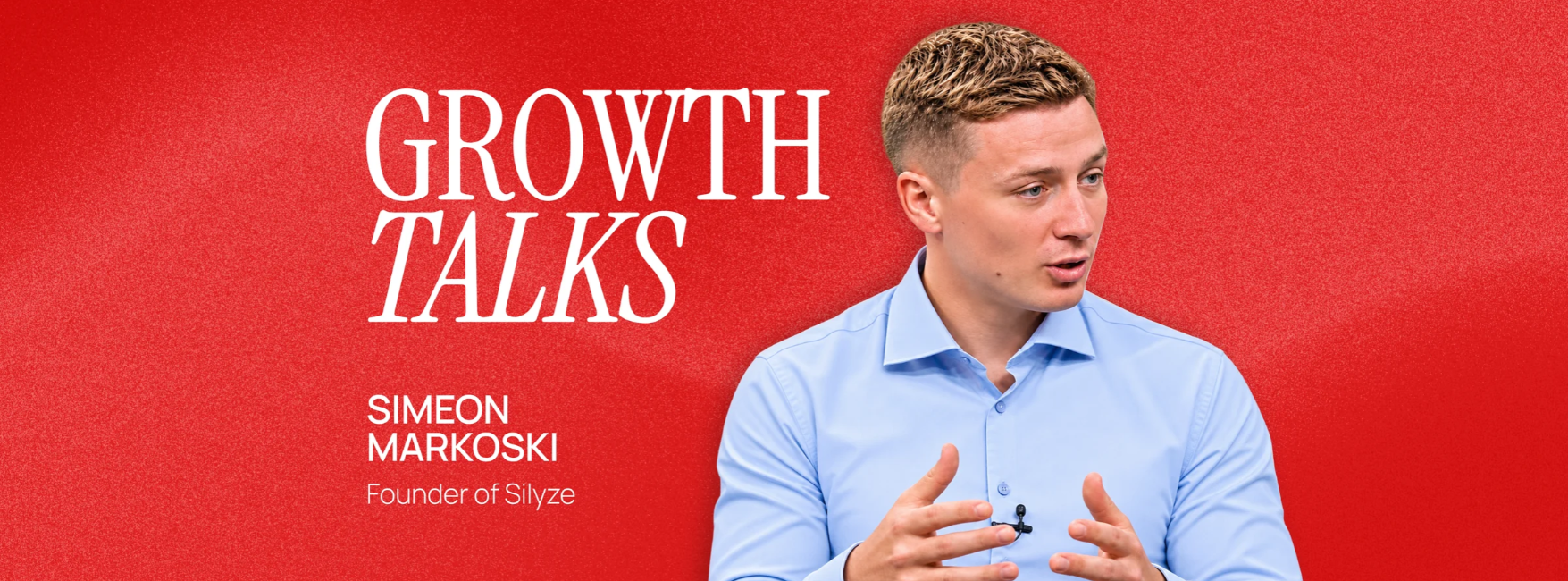
Meet Simeon Markoski, founder of Silyze, an AI software company based in Skopje building products across marketing automation, voice AI, web automation, and sports data. He’s also the founder of OptaReach, an outreach and lead generation platform that’s on its way to $5M ARR, and Telentir, an AI-powered voice agent platform.
Simeon started building his first startup at 19 in a basement with three friends and a few laptops. No office, no investors, and no idea how hard it would be. That company didn’t make it, but the lessons stuck. Fast forward a few years and he’s now running multiple products, serving clients worldwide, and bootstrapping the whole thing.
If you follow him on LinkedIn, you already know he posts constantly about what he’s building, what’s working, what’s not, and what he’s learning along the way. He’s one of those founders who shares the real version, not the polished one. And that’s why we asked him for a growth talk.
We wanted to talk to him about building from Skopje, bootstrapping in the age of AI, and why he believes talking to customers matters more than writing code.
Let’s get into it.
_________________________________________________________________________________________________________
Questions:
- What does growth mean to you?
If you have 10 customers today and 20 tomorrow, that doesn't automatically mean you've built a bigger business. For me, growth isn't just a number on a dashboard. Growth is when your MRR increases, when you can hire more people, expand your team, open new offices, and continuously reinvest in the company. I want to see the company become bigger than me. My goal isn't just to make more money. My goal is to build a company that one day doesn't depend on me.
- You tried building your first startup at 19 in a basement with friends. It didn’t work out. What are the top 3 lessons you learned?
Not every failure is a defeat. Sometimes failure is proof that you're willing to take risks. I wouldn't necessarily call it a failure. For me, it was the moment I realized how badly I wanted this and how far I was willing to go to make it happen. I'd give three pieces of advice. First, don't give up just because the results aren't coming as quickly as you expected. Second, when you start winning, don't get comfortable. That's exactly when you should push even harder. Most people do the opposite. And third, when an opportunity comes, take it. The train doesn't stop for anyone. Either you jump on when the opportunity comes, or you watch someone else take your seat.
- You run Silyze, OptaReach, Telentir, and you co-founded SportDevs before that. How do you decide what gets your time and energy, and how do you know when something deserves more or less of it?
The most dangerous thing for a founder is being busy all day while the business isn't moving forward. You can work 12 hours a day, complete 30 tasks, and still make absolutely no real progress. We focus on indicators, customer requests, and tasks that bring actual value to the business. Not every new feature is progress. Not every completed task generates revenue. Sometimes you need to stop building what you enjoy and start building what the market actually needs. I don't care how many tasks we've completed. I care how much we've moved the business forward.
- You wrote on LinkedIn that if you had to start again tomorrow, your first milestone wouldn’t be an MVP, it would be 50 real customer conversations. Can you tell us more about that?
Today, everyone is building a SaaS. Almost nobody knows who they're going to sell it to. And I've been in that exact situation myself. We focus on new features, better design, better backend infrastructure, and better AI. Then comes the moment when we actually need customers. And suddenly, we realize we might have built something nobody was asking for. You can have thousands of commits on GitHub and zero dollars on Stripe. That's the reality.
- How important is outreach for growth? A lot of companies focus on content and ads, but you built an entire product around outreach. Why?
You can have 100,000 followers and zero customers. Or you can have 200 followers and a business making thousands of dollars. Brand awareness is great, and I absolutely believe in building it. But especially in B2B, direct outreach can generate results much faster. You don't need the entire world to know about your business. You need the right 100 people to know what you're selling. You don't need an audience that applauds you. You need customers who pay you. Of course, ideally, you build both.
- “Building in public” is huge on LinkedIn right now. You do it. But where are the customers in all of that? Does sharing openly online help you sell, or is it mostly noise?
Some founders are more focused on posting about building a business than actually building one. Building in public is an excellent strategy. It shows the reality behind entrepreneurship, builds trust, and creates opportunities. But there's another side to it. You can get 50,000 views on LinkedIn and not generate a single customer. That's why I think it's completely healthy to disappear from the public eye sometimes, focus on your product, and come back with something meaningful. Don't build a business just to have something to post about. Post because you're actually building a business.
- A lot of people say SaaS is dead and distribution is the new product. You’re bootstrapping a SaaS to $5M ARR. What do you think about that?
The best product doesn't always win. Sometimes the product that everyone knows about wins. You can build a technically superior product and still lose to a competitor who is better at marketing and sales. That's the harsh reality. But I also don't believe you can build a sustainable business with a bad product. Distribution opens the door. Your product determines whether the customer stays. That's why you need to build both at the same time.
- Bootstrapping sounds great in a LinkedIn post, but what does it look like on a bad month? Is it revenue or survival?
When you don't have an investor behind you, every bad decision comes directly out of your own pocket. That's bootstrapping. You don't have millions to experiment with. You don't have an unlimited budget for hiring, marketing, or new ideas. You have to think carefully about every dollar you spend and how to get the most value out of it. And sometimes, it's extremely difficult. But I genuinely believe that, in our case, it will pay off in the long run. Maybe we're growing more slowly, but I want to build something that is truly ours.
- You’re building an AI company from Skopje, not San Francisco, not London. What’s that like? What are the advantages and what’s harder?
I want to be able to say one day that I built a global company from Skopje, Macedonia, without having to move to Silicon Valley. Pause and smile. Jokes aside, my family and the people closest to me are here. It means a lot to me that they can follow the entire journey and be part of what we're building. To be completly honest, I haven't been to San Francisco or London yet, so I can't honestly compare the experience. But today, the internet gives you the opportunity to build from Macedonia and sell to customers around the world. You don't have to be born in Silicon Valley to have Silicon Valley-sized ambitions.
- You said you’ve spent days building features customers barely noticed. What’s the most expensive lesson you’ve learned about building the wrong thing?
If I could go back in time, I'd write less code and talk to a lot more potential customers. As developers, we often think the solution to every problem is another feature. No customers? Let's add a new feature. No sales? Let's improve the UI. No growth? Let's build another product. But sometimes, technology isn't the problem at all. The problem is that we don't know how to reach customers. You can spend six months building something that six conversations with potential customers could have told you nobody needed.
- What advice would you give to a young developer in Skopje or anywhere in the Balkans who wants to start building their own thing?
If you wait until you're ready, you'll probably never start. Start immediately. You don't need a perfect idea, investors, a team, or a lot of money. Go to competitions, meet people, apply to startup programs, and build your first product. You'll make mistakes. You'll get rejected. There will be moments when you question everything. But that's part of the process. The most expensive mistake you can make in your twenties isn't starting a business that fails. It's never trying in the first place.
- Last one, just for fun. What’s something about you that has nothing to do with startups or code?
I don't want to build a successful company and lose the people who made that success meaningful in the first place. I'm extremely ambitious, but my family and the people closest to me are just as important. I enjoy spending time with them, going to the gym, and having a life outside work. It's not always easy to balance everything, especially when you're building multiple products. But for me, success won't mean much if I don't have anyone to share it with.