AI’s data centers are just us, copied
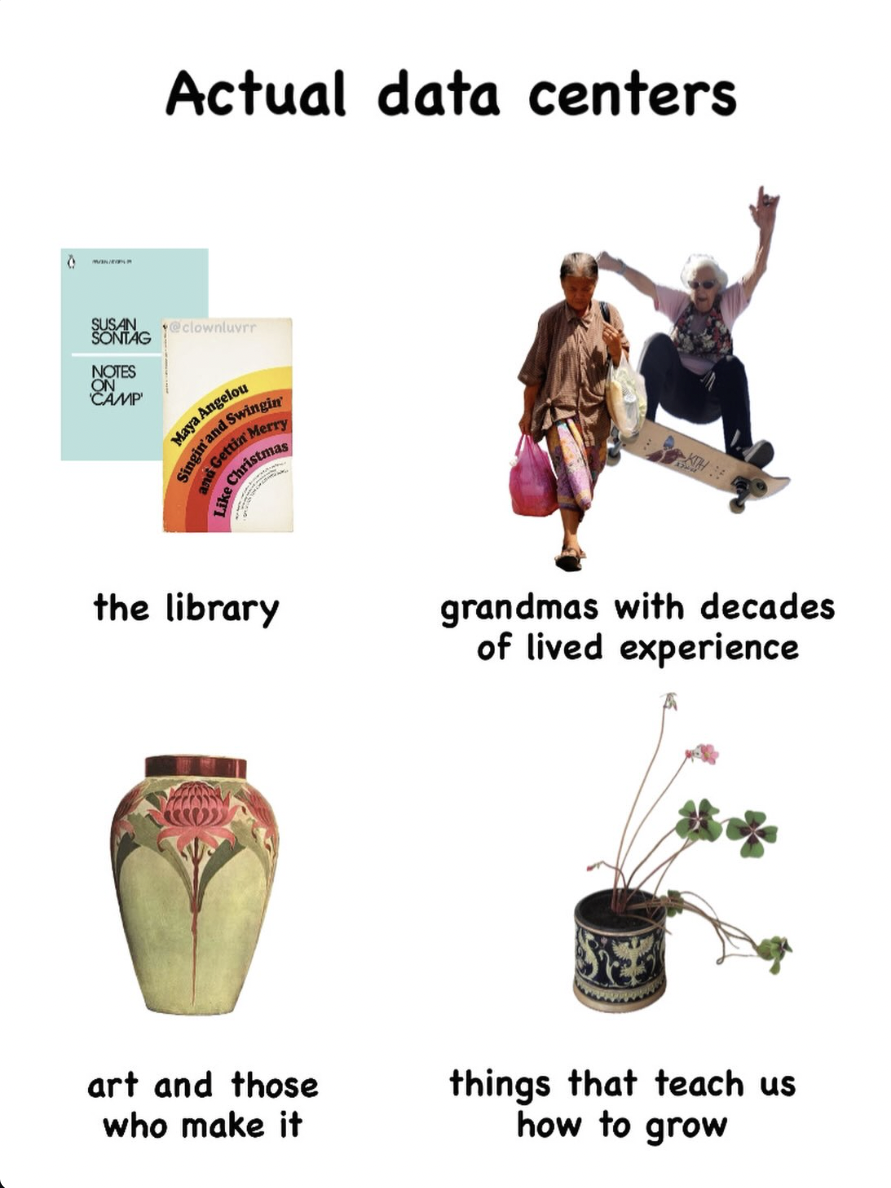
While scrolling in Instagram, I came upon a post. It was titled “Actual data centers,” and instead of showing rows of humming servers, it showed four things: a shelf of books, two grandmas with decades of lived experience, a piece of pottery and the people who make it, and a small plant, the things that teach us how to grow.
That's the joke, and it's a good one. :)
We keep talking about data centers as these giant buildings full of machines, when the real places our knowledge comes from are libraries, old people, artists, and the slow business of living long enough to learn something. The post is from @clownluvrr on Instagram, and it caught my attention because it flips the whole story on its head.
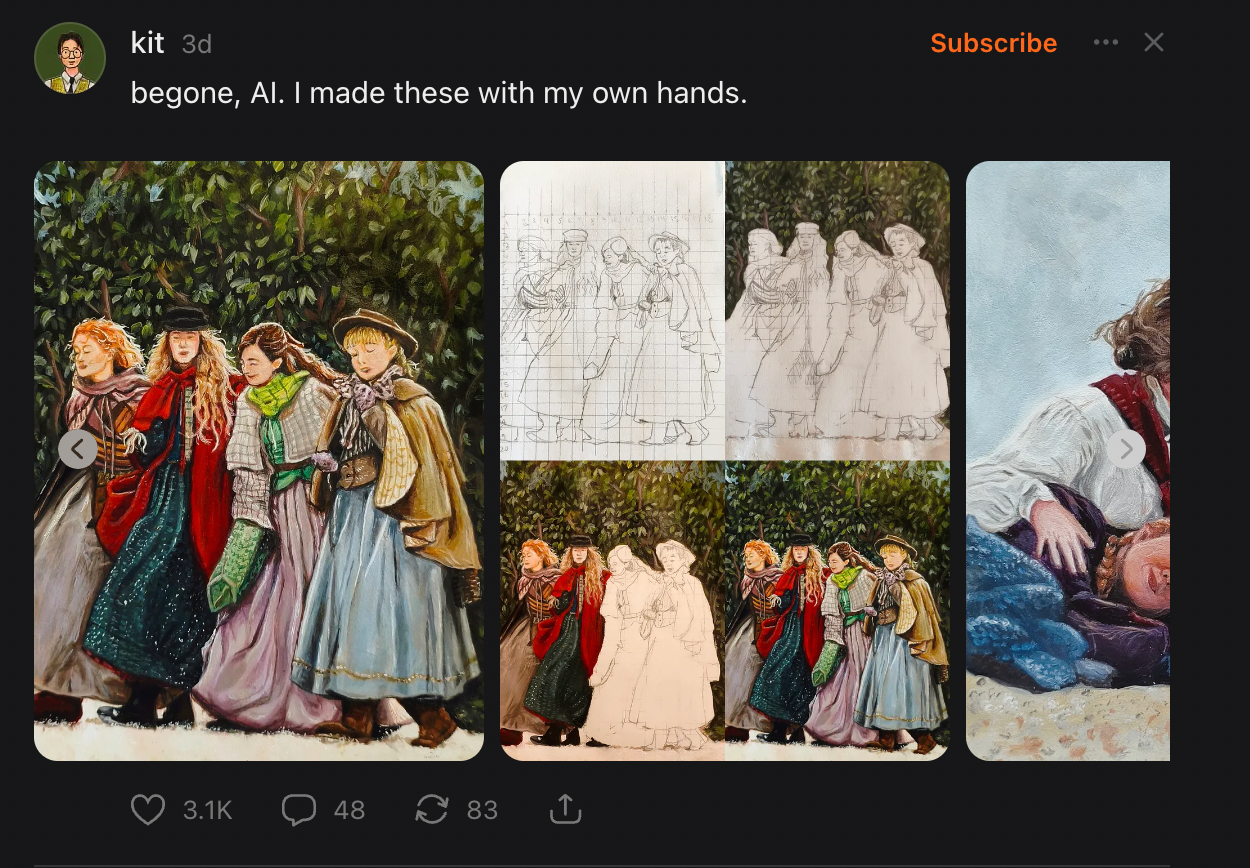
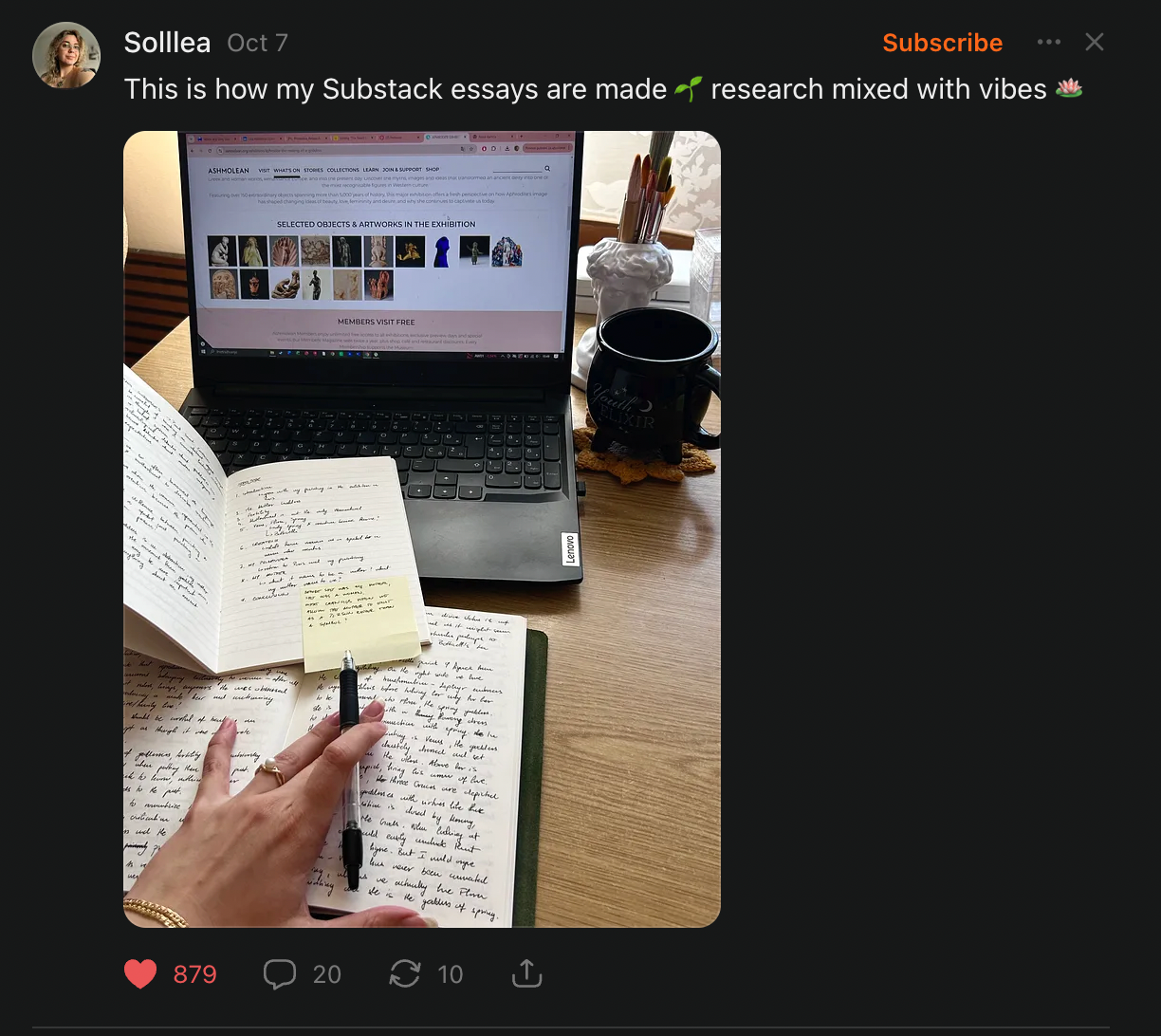
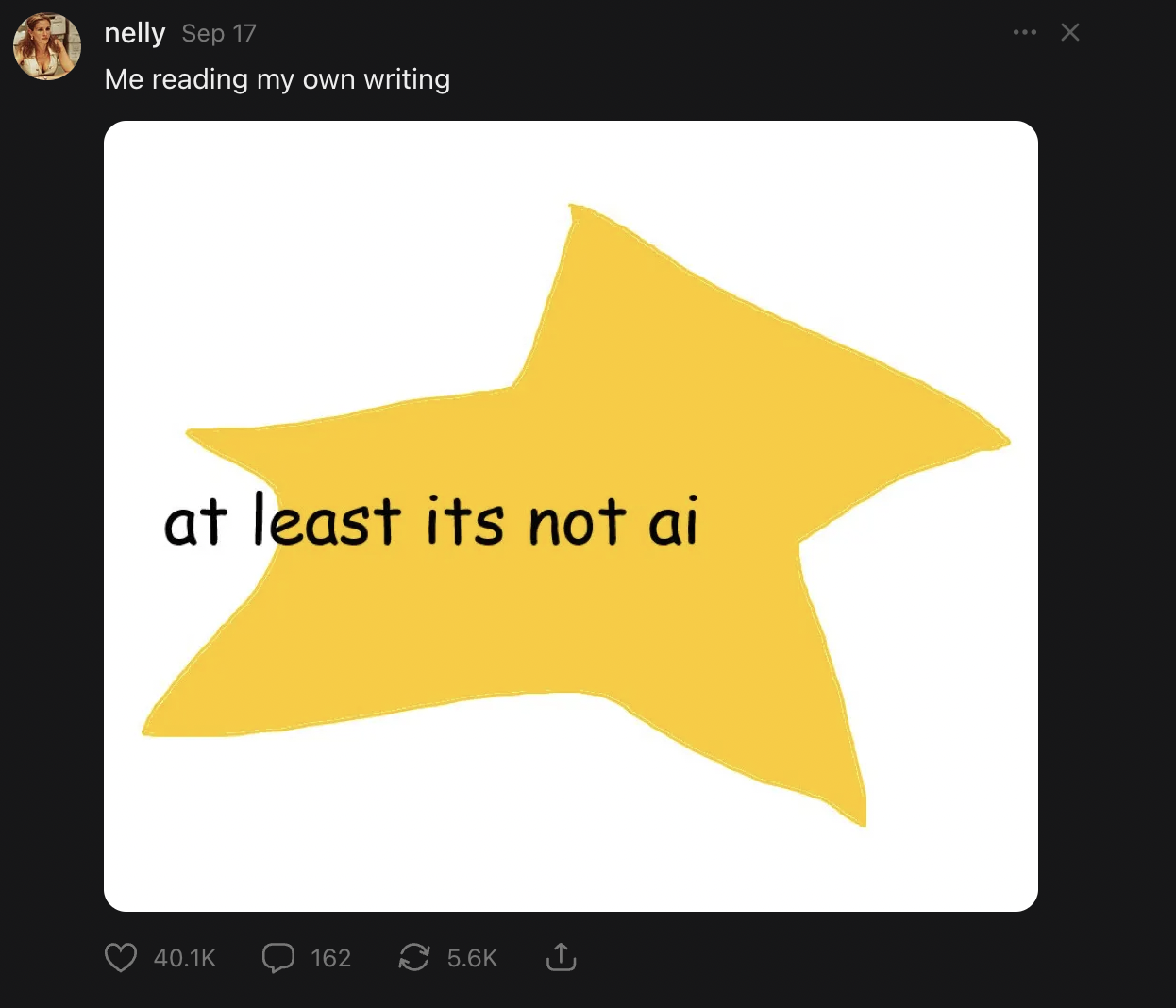
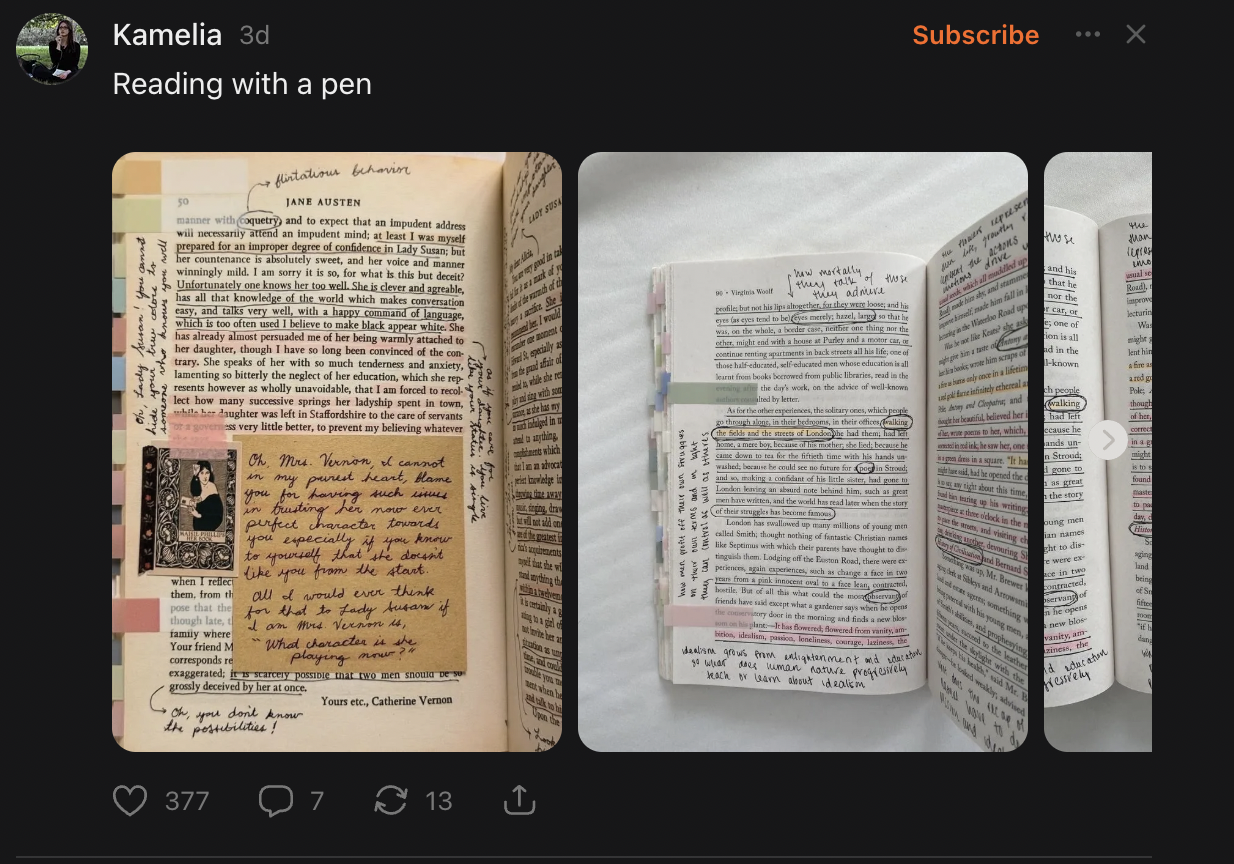
People have always been creative. And that creativity looks different depending on where people spend their time online now. There are places built around loving AI, using it, showing off what it can do. And then there are places where people are almost proud of the opposite, proud of not using it at all. Substack has become one of the loudest corners of that second world. Scroll for a few minutes and you'll find a wonky hand-drawn star with “at least it's not ai” written across it, posts tellin and the art is made with their own hands, a painter captioning her work “I did this with my hands,” someone sharing pages covered in their own messy notes under the title “reading with a pen.” A writer sharing notes of how her articles are made (based on handwriting and research)

There's even a widely shared piece by the writer Shawn Smucker called “Please Use AI,” which sounds like an endorsement until you read it. It's the opposite, a sarcastic little poem about all the human moments we'd lose if we handed them to a machine. The meal plan you'd get from a tool instead of the friend who'd have told you about her garden and her father's diagnosis. The wedding toast written by a chatbot instead of the parent who changed the diapers. It's funny and it aches, and the thousands of comments underneath it tell you how many people feel the same.
So that's the setup. Two worlds, both of them growing, both of them sure they're right. Before I say where I land, I want to understand what everyone's arguing about. And how are those two worlds connected?
On one side you have the people who love making things by hand, the painters and the writers and the ones filling notebooks on a Sunday, and they want nothing to do with AI because for them the making is the whole point. That’s beautiful, and it’s completely fair. On the other side you have the people who reach for AI all day, who don’t spend much time thinking about the human touch, who just want the thing done and move on. Also fair. But here’s what neither side tends to notice. The artists who refuse to touch it are exactly the people AI learned from in the first place, their words and their images and their ideas poured into it long before they ever said no. And the people using it all day are feeding it more with every single prompt, handing over their questions and their work so it can learn a little more. Two camps who think they’re opposites, pouring themselves into the very same place. Because deep down, under all the arguing, AI is just us. All of us, the makers and the users, gathered into one machine that hands our own creativity back to us at speed.
So, let’s get back to data centres.
What is a data center, really, and where does all of this come from?
So what is a data center, really?
Strip away the mystery and a data center is a very large building full of computers. Thousands and thousands of them, stacked in rows, running day and night. When you ask AI a question, you're not talking to a brain in the sky. You're sending a message to one of these buildings, where a machine works out an answer and sends it back, usually in a second or two. This is how I would explain it to a kid.
The reason these buildings are enormous is that AI is hungry. The computers run so hot that a big chunk of the building exists only to cool them down, often with water. And the numbers are hard to picture. A single AI data center can use as much electricity as 100,000 homes, and a large one can drink up to five million gallons of water a day keeping itself cool, about what 16,000 households use. Zoom out to all of them together and in 2025 the world's data centers used more electricity than all but ten countries on earth, produced carbon on the scale of a mid-sized nation, and used over a trillion gallons of water.
How it learns, and where it gets its ideas
Here's the part that connects back to that meme. Where does AI get everything it knows?
From us. All of it.
Before an AI model can answer anything, it has to be trained, and training means feeding it a staggering amount of material that humans made. Books, articles, forum threads, code, photographs, paintings, recipes, arguments, poems, the whole sprawling mess of things people wrote and shared and built over the years. The model reads across all of it and learns the patterns, which words tend to follow which, what a good sentence looks like, how a face is usually shaped. Then when you ask it something, it stitches together an answer from those patterns, fast. In a blink of an eye.
It doesn't know things the way our grandmothers know them. It never lived through anything. It absorbed what we made and learned to hand it back quickly. The library, the artists, the people with decades of experience, all of it got poured in. In a strange way, that meme was right. The actual data centers were us the whole time. The building full of machines is the copy.
That's also why the cost sits so heavy. Most of the energy these buildings burn doesn't go to the one-time training, it goes to answering the billions of small everyday questions people ask, around 90% of the power. Every time we ask it something we didn't need to ask, the machines run a little longer and the water warms a little more.
So what's inside one of these buildings?
If you walked into one, the first thing you'd notice is the noise and the rows. A data center is mostly long aisles of metal shelves, called racks, and every rack is packed with computers stacked one on top of another. These are the five pieces that make the whole thing work, and once you see them, the magic turns into plumbing.
The computers themselves are the brain. Each one is a server, and inside every server are the chips that do the actual thinking. Some are the same kind of chip that's in your laptop, fine for everyday tasks. But the ones that run AI are a different, far more expensive kind called GPUs, chips that were first built to draw video game graphics and turned out to be very good at the kind of math AI needs. They're so hungry that a single rack of these AI chips can pull about ten times the power of a normal rack. That one fact explains most of the cost.
Then there's the power. All that electricity has to come from somewhere, so a data center plugs straight into the grid through big transformers, and because the machines can never be allowed to blink off, there are rooms full of batteries to bridge a sudden dip and backup generators standing by for a real outage. In a lot of these buildings, power is the single biggest running cost.
The next piece is cooling, and it's a bigger deal than people expect. All that electricity turns into heat, and chips that get too hot break, so a huge part of the building exists only to carry the heat away. Older places just blew cold air through the room. The newer AI sites run water right up to the chips through little metal plates, and some even sink the whole machines into special liquid that soaks up the heat. This is where a lot of the water goes.
After that comes the networking, the thin fiber cables that carry your question in and the answer back out, fast enough that it feels instant. And finally there's storage, the place all the data actually sits, a mix of quick drives for the things used constantly and slower, cheaper ones for the stuff that's rarely touched.
Here's what struck me putting it together. If you add it all up, most of a data center isn't even the thinking part. The chips that do the real work are a slice of it. The rest is power, batteries, generators, pipes, fans, and water, a whole building built mostly to feed and cool a small, very hot pile of computers. We picture a brain. It's closer to an engine room.
Why some people want nothing to do with AI
A while ago we wrote about why coders tend to welcome AI while artists tend to resist it. The short version is that for a developer, AI is a tool that removes tedious work. For an artist, the work itself is the point, so a machine that does it for you isn't help, it's a threat to the whole reason they make things.
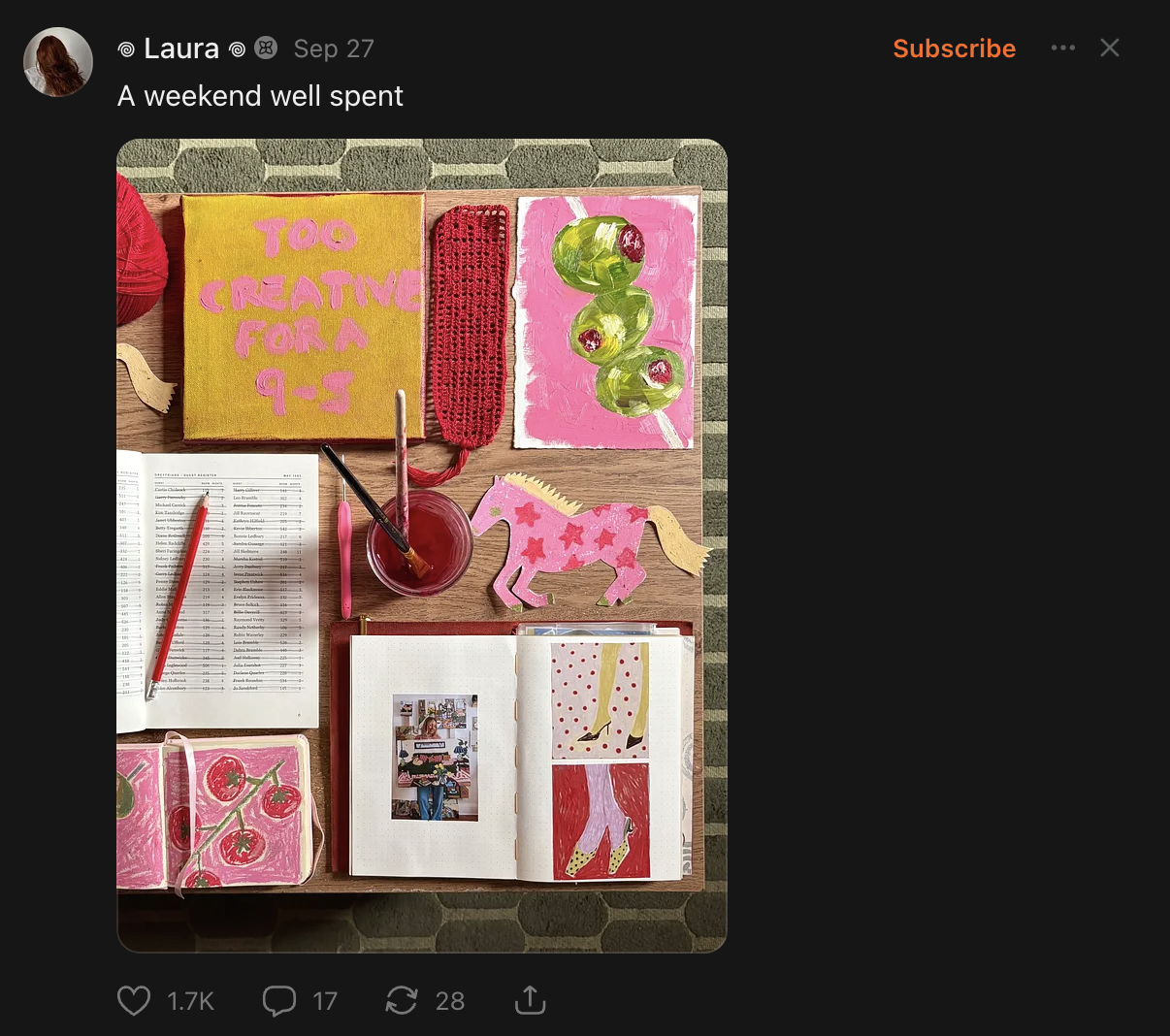
You can feel that difference all over the creative internet right now. The people posting their handwritten notes, their clumsy paintings, their weekends spent making something slow and imperfect, they're not confused about whether AI could do it faster. They know it could. That's exactly why they're planting a flag. When one of them paints a little canvas that says “too creative for a 9-5” and shares it next to her sketchbooks, she isn't competing with a machine on speed. She's saying the slowness is the whole point, the clumsiness is proof a person was there.
I don't think these people are wrong, and I don't think the ones using AI every day are wrong either. I'm somewhere in the middle, and I suspect most honest people are, even the ones posting the loudest.
My conclusion
Those data centers, for all their size and all the water they drink, are built out of what people made first. Every answer the machine gives you is a remix of something a human once wrote, drew, solved, or figured out the slow way. It's us, gathered into one place, with answers that travel very fast.
And every time we use it, we feed it a little more. We hand it our questions, our writing, our work, and it learns from that too. The thing is a mirror we keep polishing.
So I don't think the answer is to pick a team, the proud users or the proud refusers. Use it, yes, but use it for what matters.
The actual data centers were never the buildings. They were the libraries and the grandmothers and the people making something with their hands on a Sunday. The servers are only holding the copy. The originals are still out here, still ours, still a work in progress.
Want to keep going? We've written more about AI, how we use it and what we make of it.